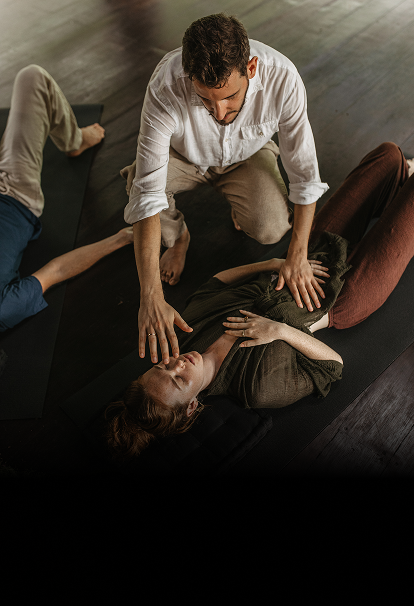
In recent years, the conversation around healing has been quietly but profoundly changing. As more people recognise the limits of purely cognitive or talk-based approaches, attention is returning to the body, not as something to fix or override, but as a source of intelligence, memory, and regulation.
At InnerCamp, this shift is not a trend. It reflects years of observing how stress, trauma, and emotional patterns live in the nervous system and the body, often beyond words. Within this context, holosomatic breathwork training and holosomatic bodywork training have emerged as professional pathways for those who feel called to work with people in a way that is grounded, ethical, and deeply respectful of the body’s rhythms.
Rather than promising quick breakthroughs or dramatic catharsis, these approaches invite something more subtle and, often, more sustainable: learning how to listen to the body and support change from the inside out.
Looking for somatic breathwork training?
This guide explains what professional somatic breathwork training and somatic breathwork certification typically include core skills, trauma-informed foundations, training hours, and what to expect from a body-based pathway that prioritizes nervous system safety.
Key Takeaways
- Holosomatic® breathwork centres on nervous system regulation rather than cathartic release.
- It differs from traditional breathwork through its emphasis on safety, pacing, and embodiment.
- Professional certification requires trauma-informed education and neuroscience foundations.
- Holosomatic® bodywork is a core pillar, not a secondary skill.
- Working with somatic emotional release requires education, discernment, and ethical clarity.
- Somatic breathwork training typically includes neuroscience, trauma-informed facilitation, and supervised practice.
- Somatic breathwork certification programs usually require 200–300 hours, plus integration and mentoring.
- Somatic bodywork training supports long-term change by working with protective patterns held in posture and muscle tone.
How to use this guide
If you’re choosing a program, start with the “At-a-Glance” section, then review curriculum topics and FAQs to compare training options.
What Is Holosomatic® Breathwork?
Holosomatic® breathwork is a breath-based practice grounded in somatic psychology, neuroscience, and trauma-informed understanding. Rather than relying on a single breathing technique, it recognizes that different nervous system states require different approaches.
At InnerCamp, there is no single “correct” way to breathe. Practitioners are trained to develop somatic intelligence: the ability to sense what is happening beneath the surface and respond with presence. This orientation is strongly supported by trauma research from experts like Bessel van der Kolk and Peter Levine, treating breath as a bridge to nervous system re-organisation.
Somatic Breathwork Training: At-a-Glance
If you’re considering somatic breathwork training, here’s what most credible programs include:
• Foundations: nervous system regulation, stress physiology, somatic psychology
• Facilitation skills: assessment, pacing, titration, and creating felt safety
• Trauma-informed practice: consent, containment, and working within scope
• Practice requirements: supervised sessions, peer practice, and integration work
• Ethics: professional boundaries, referral skills, and contraindications awareness
Holosomatic® Breathwork vs Traditional Breathwork
Understanding the difference is clarifying:
- Traditional approaches: Frequently focus on emotional release, peak experiences, or non-ordinary states of consciousness.
- Holosomatic® approach: Prioritizes safety over intensity and regulation over release. It is deeply informed by Stephen Porges’ Polyvagal Theory, highlighting how healing depends on felt safety.
In simple terms, traditional breathwork often asks the body to go somewhere; Holosomatic® breathwork asks the body what it is ready for and listens.
Holosomatic® Breathwork Certification & Training Requirements

Because breathwork accesses deep physiological layers, certification is designed for ethical responsibility. Credible programs focus on:
- Theory: Autonomic nervous system, stress physiology, and somatic psychology.
- Facilitation: How to recognize signs of overwhelm or shutdown.
- Trauma-Informed Practice: Influenced by Pat Ogden, emphasizing consent and containment. Most professional certifications involve between 200 and 300 hours of training, including supervised practice and reflective integration.
What You Learn in Holosomatic® Bodywork Training
Within InnerCamp’s approach, bodywork is a central pillar. The body holds information that breath alone cannot always access muscle tone, posture, and subtle protective responses.
Holosomatic® bodywork training teaches practitioners to attune to the body’s responses in real time. Touch, when used, is non-invasive and guided by nervous system feedback. This approach is informed by Allan Schore’s research on relational neuroscience, focusing on creating conditions where the body feels safe enough to let go of what it no longer needs to hold.
Somatic Emotional Release: What It Is (and What Training Emphasizes Instead)
Many people discover somatic work while searching for somatic emotional release or somatic exercises to release trauma. In a professional training context, it helps to reframe the goal:
• Release can happen, but it isn’t forced or pursued as the primary outcome.
• Training emphasizes regulation, pacing, and integration so the nervous system doesn’t get overwhelmed.
• “More intensity” isn’t the same as “more healing”, especially for trauma histories.
A trauma-informed approach supports the body to unwind protective responses gradually, with consent and stability, rather than chasing catharsis.
Who Is This Training Best For?
This pathway can also complement broader somatic therapy training for practitioners who want a nervous-system-informed approach (within a non-clinical scope unless licensed).
This pathway resonates with coaches, yoga teachers, bodyworkers, and wellness professionals who feel the limits of purely verbal approaches. It is ideal for those exploring somatic therapy training, even in non-clinical roles. As Gabor Maté reminds us, healing requires compassion, context, and safety, not intensity or pressure.
Typical Curriculum Topics in Somatic Breathwork Certification
While every school differs, a strong somatic breathwork certification pathway usually covers:
• Autonomic nervous system basics (stress cycles, threat responses, recovery)
• Polyvagal-informed facilitation principles (creating safety, connection, titration)
• Somatic tracking and practitioner attunement (reading breath, tone, and cues)
• Contraindications and client screening (when to adapt, pause, or refer out)
• Session structure: opening, pacing, integration, and follow-up support
• Ethics and scope of practice (what the training is and isn’t)
FAQs: Frequently Asked Questions
What is the main goal of Holosomatic® Breathwork?
The primary goal is nervous system regulation. Unlike other methods that seek intense emotional catharsis, Holosomatic® Breathwork focuses on safety, pacing, and helping the body reorganize its stress responses sustainably.
How does Holosomatic® Bodywork differ from massage?
While massage often focuses on manipulating tissue, Holosomatic® Bodywork is about "listening" to the nervous system. It uses non-invasive touch and somatic presence to support the body’s own ability to release chronic tension and trauma patterns.
Is InnerCamp's certification trauma-informed?
Yes. Every aspect of the Somatic Breathwork & Bodywork Certification is built on trauma-informed principles, incorporating the work of Peter Levine, Stephen Porges, and Pat Ogden to ensure practitioners can facilitate deep work without retraumatization.
How many hours of training are required for certification?
A professional Holosomatic® certification typically requires between 200 and 300 hours of study. This includes theoretical education in neuroscience, practical facilitation skills, and supervised sessions.
Can I practice Holosomatic® Breathwork if I am not a facilitator?
Yes. This training is designed for a wide range of professionals (coaches, yoga teachers, bodyworkers). However, it is taught wit
ih a clear ethical scope: it is a powerful tool for wellness and regulation, but it is not a replacement for clinical psychotherapy.
How do I choose the right somatic breathwork training program?
Look for a program that teaches nervous system foundations, prioritizes trauma-informed pacing, includes supervised practice, and is clear about scope, ethics, and contraindications.
Is somatic breathwork certification the same as becoming a facilitator?
No. Somatic breathwork certification can train you to facilitate regulation-focused wellness sessions, but it does not replace clinical education or licensure required for psychotherapy.